
France's Unrest Is Now the Worst in Years: What's Happening, and 3 Things to Do If You're Caught in It
Wednesday, October 28, 2026

Three weeks ago we wrote about high school students blockading their schools in France. Since then, that movement has grown into the country's worst unrest in years: hundreds of thousands of people in the streets on back-to-back Saturdays, looting and fires in dozens of cities, metro stations closed and, in some Paris neighborhoods, overnight curfews.
Here's a plain-English update on what's happening as of October 28, 2026, followed by three practical things to do if you ever find yourself in the middle of it, whether you're traveling in France or unrest breaks out closer to home.
What's happening in France
The protests started in mid-September, when high school students blockaded schools over teacher shortages, overcrowded classrooms, run-down buildings and an admissions system many see as unfair. Over the following weeks, unions, teachers, nurses, ecologists and former "yellow vest" activists joined in, and the movement widened into anger over the cost of living, high fuel prices and government spending cuts.
- Saturday, October 17: France's Interior Ministry counted about 550,000 marchers in 110 demonstrations (organizers said 800,000). Mostly peaceful marches turned into looting, vandalism and clashes in many cities. Thousands of businesses were damaged, Limoges' historic city hall was set on fire, and more than 2,000 people were taken into custody.
- October 19 to 20: Overnight curfews were imposed in parts of Paris and other cities, including Lille, and the U.S. Embassy issued security alerts for Americans in France.
- Saturday, October 24: About 410,000 people marched nationwide, according to the Interior Ministry, with more than 70,000 police and gendarmes on duty. At least 24 Paris metro stations closed, the Louvre and Musée d'Orsay shut for the day, and protests were banned in Montpellier, Rouen and Nice. Interior Minister Laurent Nuñez said 1,435 people were arrested.
- October 26: The government announced concessions, including caps on some class sizes, billions of euros for school and campus repairs, bigger student grants and a new university admissions system by 2028. Student leaders said it wasn't enough and vowed to keep going.
What comes next
President Macron has said more unrest is likely this coming weekend, and organizers have called a nationwide day of demonstrations for November 5. Similar protests have also flared in Belgium, Italy, Spain, Portugal and Greece. Whatever you think of the causes, and there are real grievances and real concerns about both the violence and the police response, this is not over yet.
Most people in France are simply trying to get to work, pick up their kids or enjoy a trip. Those are the people this guide is for.
3 things to do if you find yourself in the middle of it
1. Read the signs early, and move sideways, not through
The best time to leave a protest area is before it turns. The warning signs are usually visible minutes, or even hours, ahead:
- Shops pulling down shutters or boarding up windows in the middle of the day.
- Police vans gathering, officers putting on helmets, or lines forming across a street.
- Metro stations suddenly closing, or crowds all moving in one direction.
- Masked groups, things being thrown, or a sharp, peppery smell in the air (tear gas).
When you notice them, don't stop to watch or film. Turn down a side street and move away at an angle, not through the crowd and not toward the police line. If you're caught in tear gas, move upwind and to higher ground, don't rub your eyes, and rinse with clean water as soon as you can.
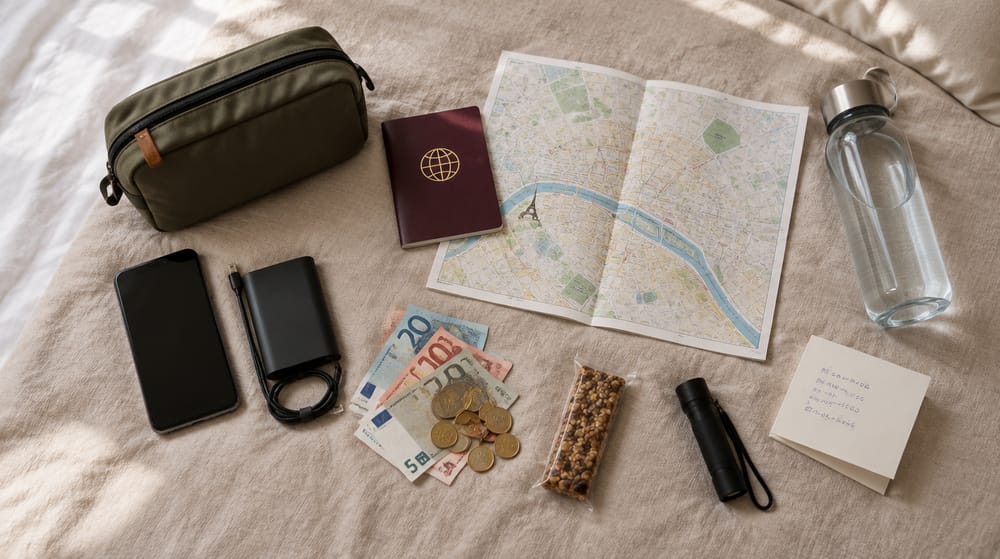
2. Carry a small "24-hour pouch," then plan to sit tight
During unrest, the trouble usually isn't the protest itself. It's what follows: closed metro lines, a curfew, shops shut for the evening, a hotel you can't get back to. A small pouch on your body (not in a backpack you might drop) covers you for a day:
- Phone plus a charged power bank and cable.
- Some cash in small bills. Card readers go down when stores close.
- A copy of your passport or ID, and your hotel address written on paper.
- Any medications you take, plus water and a snack.
- An offline map downloaded on your phone, or a small paper one.
Once you've reached somewhere safe, like your hotel, a friend's place or a calm café well away from the route, stay put until things settle. Waiting a few hours is almost always safer than trying to cross a tense part of the city.
3. Know who to call, and how you'll get updates
- Americans: enroll in the State Department's free Smart Traveler Enrollment Program (STEP) before you go, so you get embassy alerts by email.
- Save the U.S. Embassy in Paris number in your phone: +33 1 43 12 22 22. In any emergency in France or the EU, dial 112.
- Check closures before you move: RATP and Île-de-France Mobilités for the Paris metro, SNCF for trains. Follow English-language French news like France 24, RFI or The Local.
- Agree on a simple check-in with family back home: who you'll text, and when. If they don't hear from you by a set time, they know to call the hotel or the embassy.
Not traveling? The same plan works at home
You don't need to be in Paris for this to matter. Protests, big-game celebrations that get out of hand or tense events can disrupt any American city with little warning. Spot the signs early, keep a few days of supplies so you don't have to go out, and have a family check-in plan. We covered the home version in detail in our earlier article, France's Student Riots: How to Prepare Your Household for Civil Unrest Near You (link below).
The bottom line
France is going through a hard few weeks, and more demonstrations are planned. If you're there, or headed there, the plan is simple: see it early, step away, carry a little, stay put once you're safe, and stay connected. Calm and prepared beats curious every time.
If you want the whole system for your home laid out step by step, our guide Prepared, Not Paranoid is a calm, one-weekend plan for apartments and suburban homes.
Related
Sources
This article reflects reporting available on October 28, 2026. Figures differ between officials and organizers, and situations like this change quickly. Follow local authorities and the U.S. Embassy for the latest guidance.

Hi, I Am Jane Doe
CEO Of Best Blog Ever
Lorem ipsum dolor sit amet, consectetur adipisicing elit. Autem dolore, alias,numquam enim ab voluptate id quam harum ducimus cupiditate similique quisquam et deserunt,recusandae.

Get Our Best Selling Product!
You just read about this...
Super excited about this product? We are, too! We just wrote this whole blog post that mentions it.
Ready to buy it? Get access to the Product here:
